The Room That Was Already Empty
The episode opens with Pompey’s troops walking into the Holy of Holies in 63 BC and finding nothing — no statue, no throne, no box. That single fact reframes everything that follows: whatever the Ark was, it had vanished roughly five hundred years before Rome ever heard of it, sometime around the Babylonian sack of Jerusalem in 587 BC. The Bible’s own inventory of what Babylon carried off lists the pots, the shovels and the ladles. It does not list the Ark.
Exodus 25, Decoded as an Engineering Document
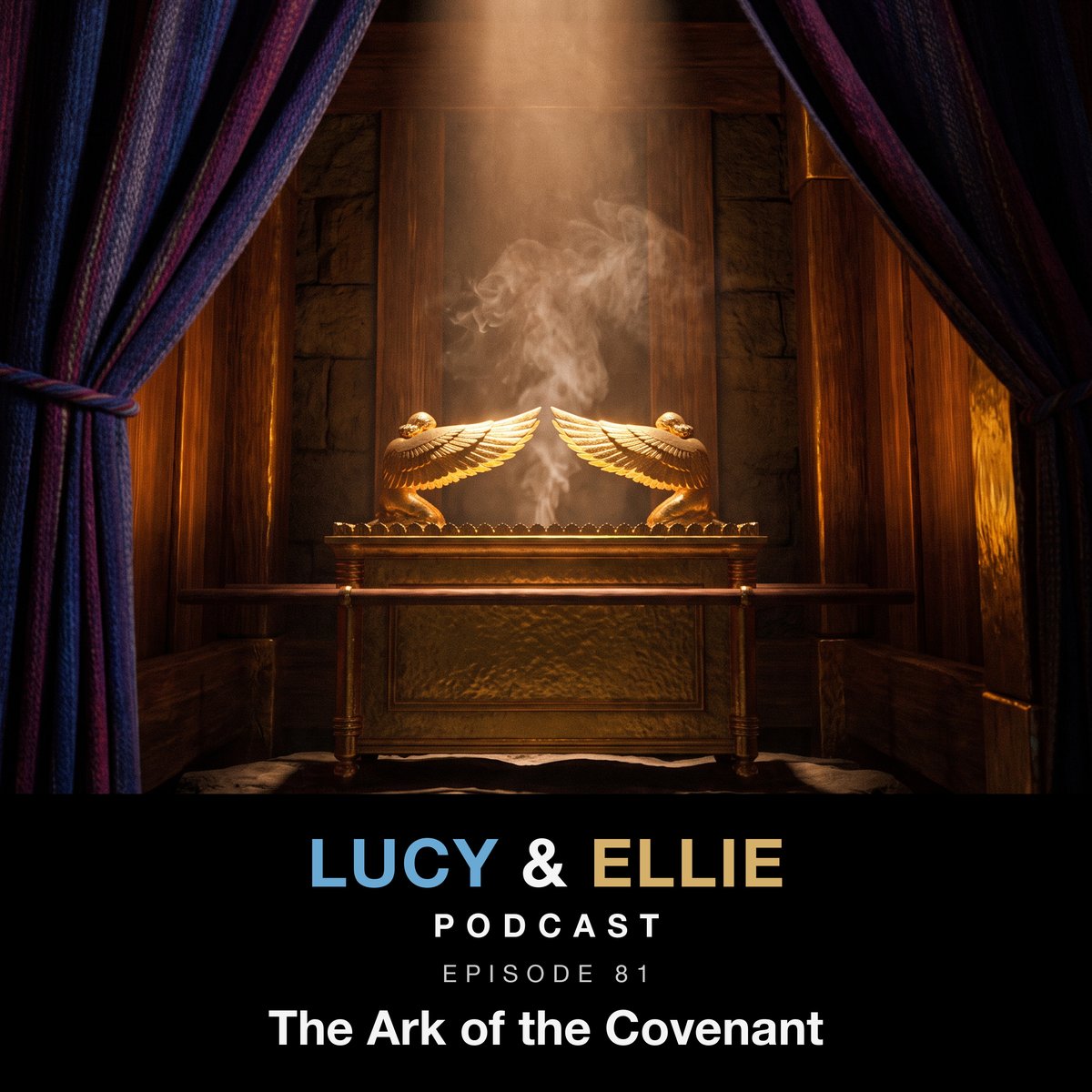
Read literally, Exodus 25 is closer to a work order than a myth: a chest a bit over a metre long (the exact figure is unrecoverable, since a cubit ran anywhere from 44 to 52 centimeters), acacia wood inside and out in gold, two poles that must never be removed, and a solid gold lid with two winged figures whose wings meet over — nothing. Lucy’s reading, backed by Egyptologist Scott Noegel’s scholarship on the Egyptian sacred bark, is that the Ark is best understood as a chair: an empty throne for a king who could not be depicted, with a legal contract — the stone tablets — filed under its feet, the way Bronze Age treaties were filed under a god’s footstool.
We Did the Arithmetic on ‘the Ark as Capacitor’
The idea that the Ark was an ancient electrical device didn’t start with Erich von Däniken — it traces to a Berlin philosopher named Bendavid in 1797, then Nikola Tesla writing in a trade magazine in 1915, then a 1978 George Lucas story conference, by his own admission, “without actually consulting Exodus.” Lucy takes the idea seriously enough to run the numbers: gold-cased walls of dry acacia wood two and a half to four centimeters thick give a capacitance of roughly one and a half to six nanofarads, storing at most four to forty-four joules — enough for one nasty jolt, nowhere near enough to melt a face or fell an army. And the gold rings pinning the interior and exterior gold together would short the whole thing out anyway.
The Powers, Event by Event
The episode tracks every recorded effect of the Ark against what history and textual criticism can actually show: the Jordan stopping at a town called Adam (a real geological phenomenon, recorded again in 1267 and 1927); the Ark’s capture and the plague at Ashdod (the “fifty thousand and seventy” dead at Beth-Shemesh turns out to be a manuscript error most translators footnote as unreliable); and Uzzah, who reaches out to steady the Ark when the oxen stumble and dies where he stands — explained in the Hebrew by a word that appears exactly once in the entire Bible and that nobody can confidently translate.
Ellie Unfiltered: The Guardian of Axum
Ellie’s block travels to a small stone chapel in Axum, northern Ethiopia, where the Ethiopian Orthodox Church says the Ark has rested since the son of Solomon and the Queen of Sheba brought it home — a tradition recorded in the fourteenth-century Kebra Nagast. One man, chosen for life, guards it; he never leaves the grounds, and nobody else, not even the head of the church, is permitted to see it. “I’m the guardian of the ark,” he has said. “I have no other name.” Ellie treats the claim with real respect while noting the single outside account on record — scholar Edward Ullendorff’s 1992 statement that what he saw in 1941 was “middle- to late-medieval construction” — and closes on an unexpected footnote: a tabot, the tablet every Ethiopian church keeps as a stand-in for the Ark, sat built into an altar in Westminster Abbey from 1870 until 2010.
The Trail, and Lucy’s Verdict
Every claimed location on Earth — Mount Nebo, the Temple Mount, Ethiopia, a drum in Zimbabwe, a hill in Ireland, a French village — gets ranked by the age of its oldest source, and the ranking does most of the debunking by itself: the earliest claim postdates the Temple’s destruction by more than four centuries. Lucy’s own verdict, offered with the counter-arguments attached rather than hidden, leans toward the Ark simply burning with the Temple or being stripped of its gold before the siege — and she flags the deepest problem honestly: there is no point in history where anyone outside the Bible can independently confirm the Ark ever existed at all.
The Takeaway
The most famous lost object in the world may never have needed to be found, because losing it — and telling people to stop looking — may have been the point all along. Jeremiah’s own text says a day is coming when people will no longer speak of the Ark, or miss it, or make another. An empty throne, an empty room, and a book that tells its readers to let it go: that is, as Lucy puts it, not necessarily a loss. It might be the plan.
📚 Sources
- Josephus, The Jewish War 1.152 (Pompey in the Temple) — perseus.tufts.edu
- Josephus, The Jewish War 5.219 (“In this there was nothing at all”) — penelope.uchicago.edu
- Josephus, The Jewish War 7.148–152 (the triumph’s spoils) — lexundria.com
- Josephus, Antiquities 6.1.4 (seventy at Beth-Shemesh) — lexundria.com
- Scott B. Noegel, “The Egyptian Origin of the Ark of the Covenant” — faculty.washington.edu
- Leen Ritmeyer, “The Ark of the Covenant: Where It Stood in Solomon’s Temple,” Biblical Archaeology Review — library.biblicalarchaeology.org
- Leen Ritmeyer interview (the rock-cutting measurements) — ritmeyer.com
- Mike Caba, “Rope-a-Dope,” Associates for Biblical Research — biblearchaeology.org
- Exodus 25; 1 Samuel 4–6; 2 Samuel 6; 2 Kings 25; 2 Chronicles 35:3; Jeremiah 3:16; 2 Maccabees 2