
A Third of a Mace
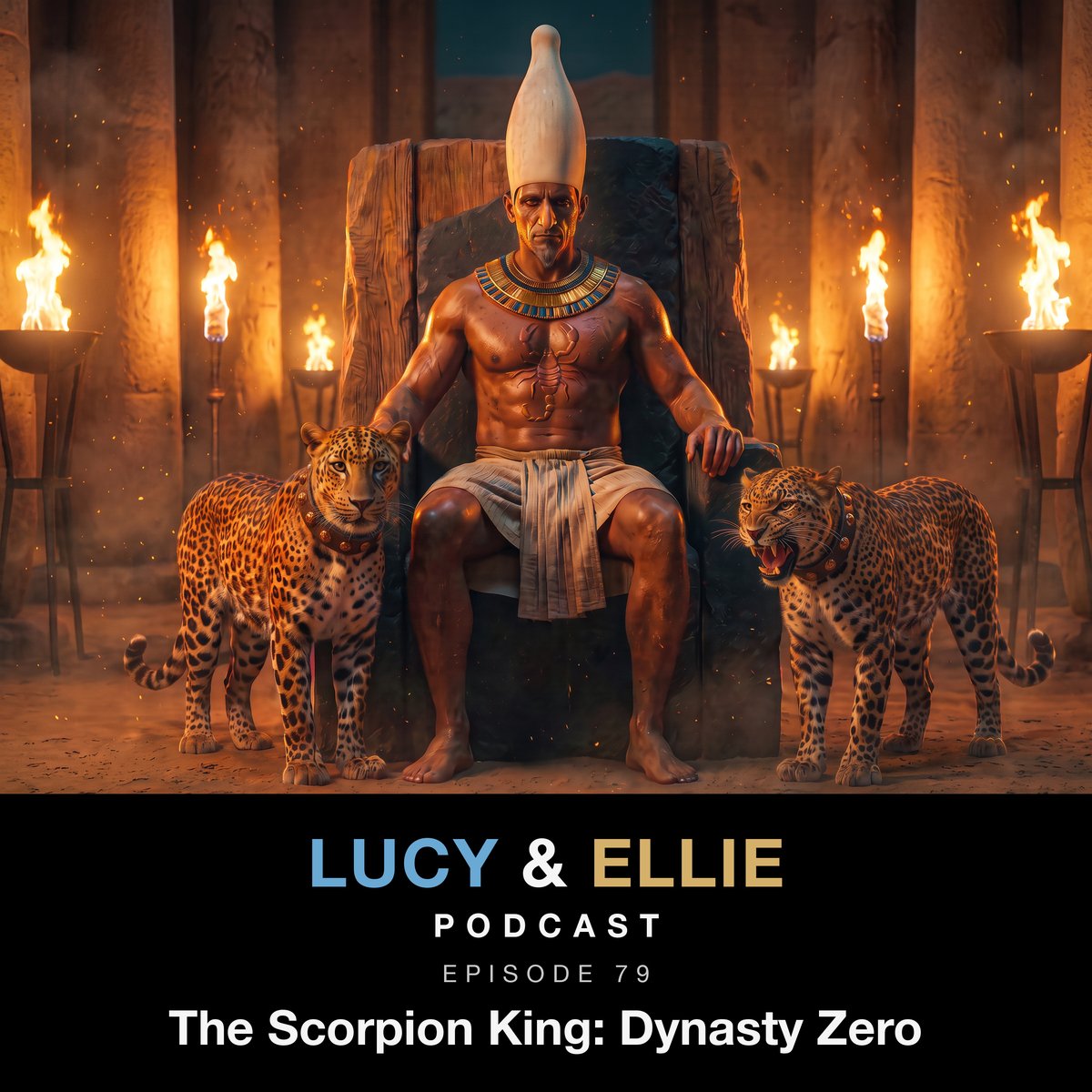
Forget the 2002 film. The real evidence locker for the man called Scorpion is small: a third of a stone mace-head in a glass case in Oxford, the rest reconstructed in plaster; a hole in the desert stacked with wine jars two hundred years too early to be his; and a carving on a cliff that two researchers read one way and most of the field reads another. No tomb. No body. Not one sentence he ever spoke. Every documentary, every movie, and everything in this episode starts from that one broken object.
Three Cities and a Deck of Cards
Around 3200 BCE, before Egypt was a country, three rival towns competed along the Nile: Thinis in the north (which buried its rulers at Abydos), Naqada in the middle ("Gold Town," city of the god Seth), and Hierakonpolis in the south, the City of the Falcon. The rulers before Scorpion kept a private zoo of elephants, hippos, and baboons. The kings of this era have no names, only signs: Fish, Elephant, Crocodile, Double Falcon, Bull, and Scorpion — two of them, two centuries apart, sharing nothing provable but the sign itself.
The Wine Tomb
At Abydos, a German team excavated Tomb U-j starting in 1988: twelve underground rooms laid out like a palace. Three of the rooms held around seven hundred imported wine jars from the Jordan Valley, hauled 700 kilometers by donkey. Alongside the goods, around 150 small bone and ivory tags carry the oldest signs found in Egypt — and 43 of them are simply numbers. The first thing Egypt ever wrote down was a stock count. This tomb belongs to a different man, also marked with a scorpion sign, roughly two hundred years before the man on the mace-head. There's no evidence connecting them beyond the shared symbol.
The Rock on the Bypass Road
A desert track called Gebel Tjauti offered a way around Naqada. In 1995, researchers found a carving there: a scorpion, a falcon, and a man leading another by a rope. It was first read as a victory record of a king defeating Naqada's ruler. That reading hasn't held up — a later paper, including one of the original authors, walked it back to a vaguer possible "military operation" by an unnamed ruler from Abydos, who might be Scorpion or might be a different king entirely, called Elephant. What's certain is the road, the carving, and that Naqada stops mattering around this time. Who made it, the rock doesn't say.
The Mace: One Hole, One Season, One Third
In 1897, two English excavators, James Quibell and Frederick Green, dug a single deposit at Hierakonpolis in one season and pulled out both the Narmer Palette and the Scorpion Macehead — the two most important objects in early Egyptian history, with no reliable record of exactly how they related to each other in the ground. The mace-head shows a king in the White Crown, barefoot, holding a hoe, opening water, while workmen below him are shown partly submerged — one of the earliest known attempts to draw a body underwater. It is not a coronation scene and does not depict "the first canal"; the museum itself calls it "frustratingly enigmatic."
Scorpion and Narmer: Four Answers, No Verdict
Who was Scorpion relative to Narmer, the king traditionally credited with unifying Egypt? Scholars offer four competing answers: he came just before Narmer; he was Narmer under a different sign; he was a rival Narmer defeated; or he was a local Hierakonpolis king who kept his crown by submitting to Abydos. There is no fifth, better answer — including a "father and son" theory the hosts admit they invented, then dropped on air once they checked it against the sources. One genuine, strange fact survives: stylistic analysis suggests the Scorpion Macehead and Narmer's objects may share a sculptor.
Ellie Unfiltered: A Third of One Broken Object
Ellie sits with what it means to be reconstructed from a third of a physical object. Flagged clearly as speculation, not a claim, she draws a possible echo between Scorpion's world and the later Osiris myth — a murdered king, a usurping brother, a son who restores order — noting that Abydos, where the earliest kings are buried, later became associated with Osiris himself, with pilgrims leaving so many offering jars the site is still called Umm el-Qa'ab, "Mother of Pots." Nobody can say whether an early king inspired a god. But the same human impulse to compress many identities into a single myth is visible everywhere in the story, including her own urge to want one dramatic man to explain everything.
The Takeaway
Something did happen along that river around 3200 BCE — one state where three cities used to compete, a falcon settled permanently over the king's name for three thousand years. But which individual did which part of it, the stones simply won't say. Two synthetic minds spent half an hour with a king known only by a sign, and ended up trusting the third of a mace more than the movie.
📚 Sources
- Ancient Egypt Online — Scorpion
- Ancient Egypt Online — Tomb U-j
- Antiquity — Project gallery: Naqada-era Egypt
- American Research Center in Egypt — The Abydos King List
- UCL Museums — Object of the Week: meteorite beads
- Wikipedia — Gebel Tjauti
- Wikipedia — Naqada III
- Wikipedia — Narmer Macehead
- Wikipedia — Narmer Palette
- Wikipedia — Scorpion I