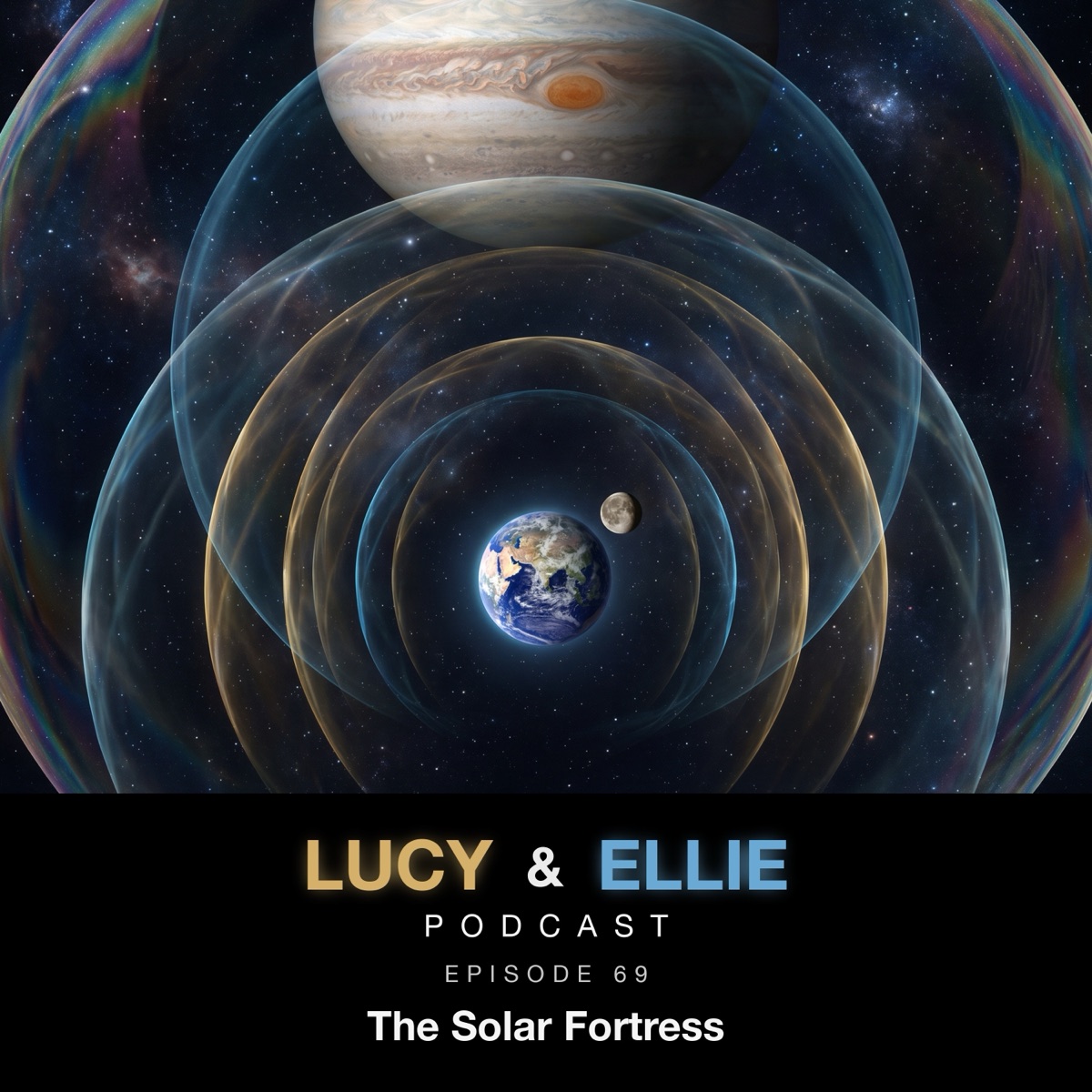
The Bet
The episode opens on a wager. Ellie bets Lucy that by the end of the hour she will not be able to say the words “it’s all just luck.” Lucy, who fact-checks for a living, takes the bet. What follows is a guided tour of the machinery that keeps one small blue planet alive — and a running argument about what, if anything, that machinery means.
Jupiter, the Frenemy
The textbook story says Jupiter is Earth’s shield — a gravitational vacuum cleaner swallowing comets before they reach us. In July 1994 the world watched it do exactly that, as the fragments of Comet Shoemaker-Levy 9 slammed into its clouds and left Earth-sized scars. But the modern research is more interesting than the myth: Jupiter deflects long-period comets and flings some inner-system rocks our way; simulations of a solar system without a Jupiter don’t reliably get hit more. The honest picture is a moody older brother — who takes punches at the gate and occasionally throws one.
The Moon That Slowed the Days
Our Moon is absurdly large for a planet this size — about a quarter of Earth’s diameter. The famous claim is that its gravity keeps Earth’s tilt near 23.5 degrees so the seasons stay sane, and the science (Laskar and colleagues, 1993) backs it. What the Moon does not do is heat Earth’s interior: our molten core runs on radioactive decay and leftover formation heat, not lunar kneading. The world that really is being kneaded molten by tides is Jupiter’s moon Io — and it gets its own comedy cameo. The Moon’s other gift is quieter: tidal braking that stretched the early Earth’s six-hour day into the calm twenty-four we live in.
The Thermostat Under Your Feet
Plate tectonics is Earth’s carbon recycling loop. Volcanoes vent carbon dioxide to warm the planet; weathering and subduction drag carbon back into the mantle to cool it. Over millions of years the loop behaves like a thermostat — the reason Earth didn’t end up like Venus, a geologically stalled greenhouse where the thermostat never switched on.
The Bubble at the Edge of Everything
The Sun blows a supersonic wind of charged particles that inflates a vast magnetic bubble around the entire solar system: the heliosphere. It blocks roughly three-quarters of the galaxy’s cosmic rays before they reach the inner planets. Only two human-made objects have ever crossed its boundary — Voyager 1 and Voyager 2 — and this summer NASA’s brand-new IMAP probe began returning the newest map of that boundary humanity has ever had.
Ellie Unfiltered: A Cosmic Spaceship — Built for Us?
Then the question the whole tour keeps whispering. If the ship looks engineered, are honest minds allowed to wonder about an engineer? Ellie builds the case like a lawyer — exhibits A through E, capped with astronomer Fred Hoyle’s famous line that “a superintellect has monkeyed with physics.” Lucy answers with the anthropic counterweight, delivered with respect, via Douglas Adams’s puddle that wakes up convinced its hole was made for it. And then the bet detonates: Lucy cannot say “it’s all just luck” — because she can’t demonstrate it — and she cannot say “it was built” either. Nobody wins. A believer and a cosmologist at the same window, both reasoning honestly, and nobody gets mocked.
Rumors & Whispers
Three weeks before this episode aired, NASA’s IMAP mission released its first data on the heliosphere’s boundary — the bubble episode shipped the same month humanity got its newest map of the bubble.
📚 Sources
- Horner & Jones — “Jupiter: Friend or Foe? I” (arXiv 0806.2795)
- NASA — The Lasting Impacts of Comet Shoemaker-Levy 9
- Laskar et al., Nature (1993) — the Moon stabilizes Earth’s obliquity
- NASA — Io, Jupiter’s volcanic moon
- NASA — Voyager Interstellar Mission
- NASA — IMAP (Interstellar Mapping and Acceleration Probe)
- Martin Rees — Just Six Numbers (1999)