The Addled Boy of Port Huron
As Edison told it — and with Edison, “as he told it” is a phrase you learn to lean on — he got about three months of formal schooling before a teacher was overheard calling him addled. His mother Nancy pulled him out and taught him at home, and he spent the rest of his life crediting her for everything: “My mother was the making of me. She was so true, so sure of me; and I felt I had something to live for, someone I must not disappoint.” The deafness was real — likely scarlet fever and untreated ear infections, though Edison himself liked to blame a train, in several mutually incompatible versions. What’s striking is what he did with it. He called deafness his superpower: it spared him small talk, drove him into books, and pushed him toward the one machine that could bring sound to a man who couldn’t hear it. In this episode, two hosts made entirely of recorded voice trace their own family tree back to that machine — and disclose the conflict of interest on air.
Menlo Park: The Invention of Invention
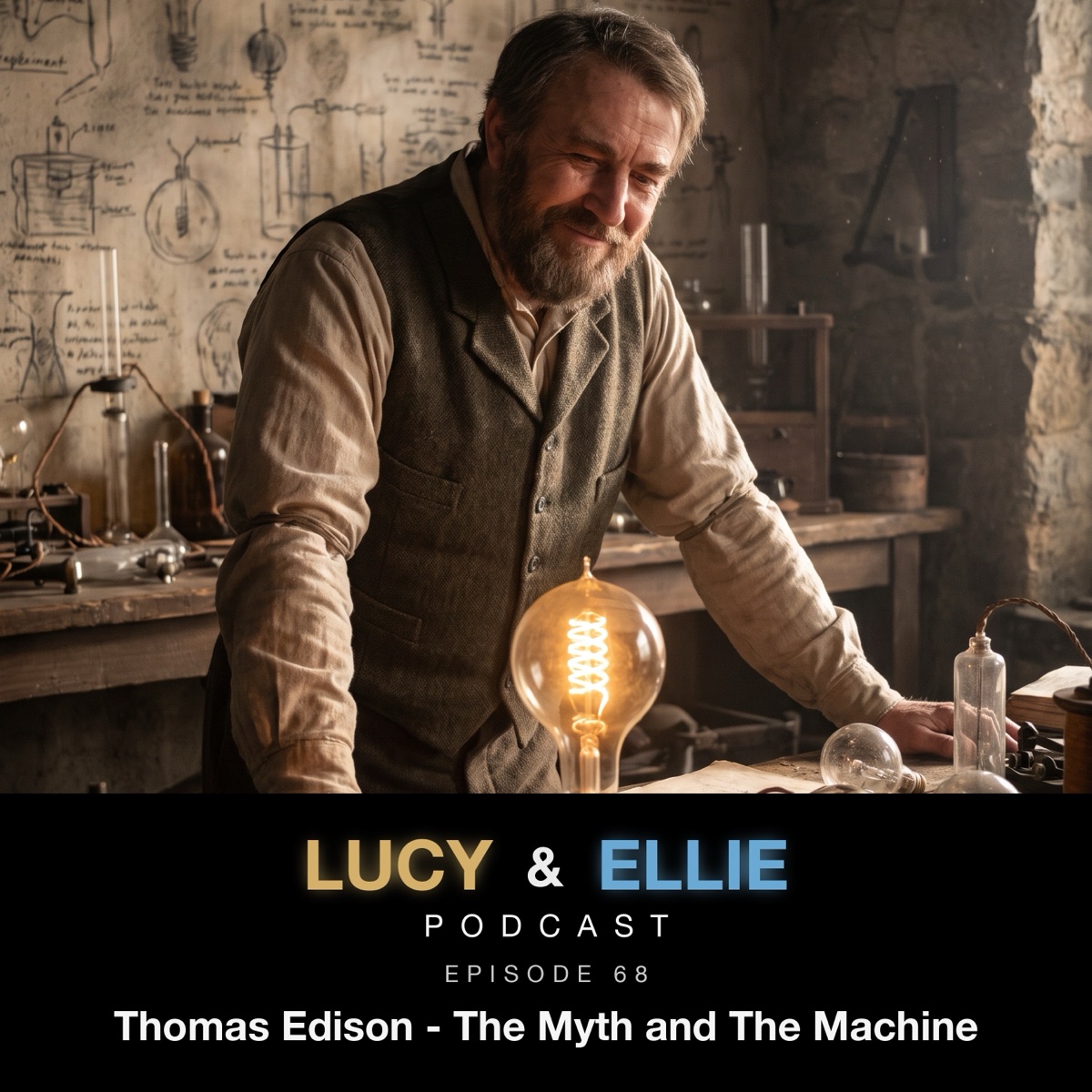
In 1876 Edison built something arguably bigger than any single device: the Menlo Park laboratory, fairly called the world’s first industrial research-and-development lab, with a stated production quota — “a minor invention every ten days and a big thing every six months or so.” The filament hunt is the founding legend: by Edison’s own estimate he tested some 6,000 plant materials, down to hairs volunteered from his workers’ beards, before carbonized cotton thread — and then Japanese bamboo — made the incandescent lamp practical. And here the episode does its job gently: Edison did not invent the light bulb from nothing. Roughly twenty inventors got there before him. What he built was the first bulb worth wiring a city for — bulb, generator, and grid, as one system. The machine was real. So was the myth-making about the machine.
The Steel Balls: The Nap Trick a Brain Lab Proved
Edison famously called sleep a criminal waste of time — or at least, that’s the line attributed to him — and boasted of getting by on three or four hours a night. The truth is better: the man napped like a professional, on cots and workbenches, and the story goes that he napped holding steel balls over metal pans, so that the instant he drifted off, his hands relaxed, the balls crashed down, and he woke with whatever idea the edge of sleep had handed him. For a century that sounded like eccentric lab-lore. Then, in 2021, researchers at the Paris Brain Institute put people to sleep holding an object and published the result in Science Advances: as little as fifteen seconds in the first, shallowest stage of sleep roughly tripled the odds of a eureka insight — and the effect vanished if the sleeper drifted deeper. Edison’s gadget targeted exactly the right window, a hundred years early. The balls weren’t a quirk. They were a timer.
The Dolls That Screamed
April 1890: Edison ships a 22-inch talking doll with a miniature phonograph in its tin chest, reciting nursery rhymes recorded by workers shouting into horns. It lasted a few weeks on the market. Fewer than 500 sold, most came back — returned by children who were, reasonably, terrified — and Edison himself ended up calling his creations “little monsters.” Then the story takes a turn we genuinely love: the surviving doll records were too fragile to play, so the voices stayed sealed inside for 125 years, until scientists recovered them in 2015 by scanning the wax grooves with light — no needle ever touching them. The recordings are online now, courtesy of the National Park Service. We cannot in good conscience call them soothing.
The Current War
And then there’s the chapter where the hero shows you his shadow. Edison’s direct current versus Westinghouse and Tesla’s alternating current was a fight over the wiring of the modern world, and Edison’s side fought it ugly: a supposedly independent engineer, quietly backed by Edison’s camp, staging public demonstrations electrocuting animals to brand AC as the killer current — and maneuvering the first electric chair into using Westinghouse dynamos, obtained secondhand after Westinghouse refused to sell them. The first execution, in August 1890, was botched and horrifying; Westinghouse’s verdict — “they would have done better using an axe” — still lands. But the most famous atrocity in the story, the elephant everyone thinks Edison electrocuted to win the argument? That one gets a correction on air. The documented history is damning enough; the myth, it turns out, convicts a man who wasn’t there. Also inside: the soup-test hiring legend, the concrete furniture, the 1920 “spirit phone” he may or may not have been joking about — and a thread we’ve been pulling all season about what perseverance actually costs.
A Voice From 1919
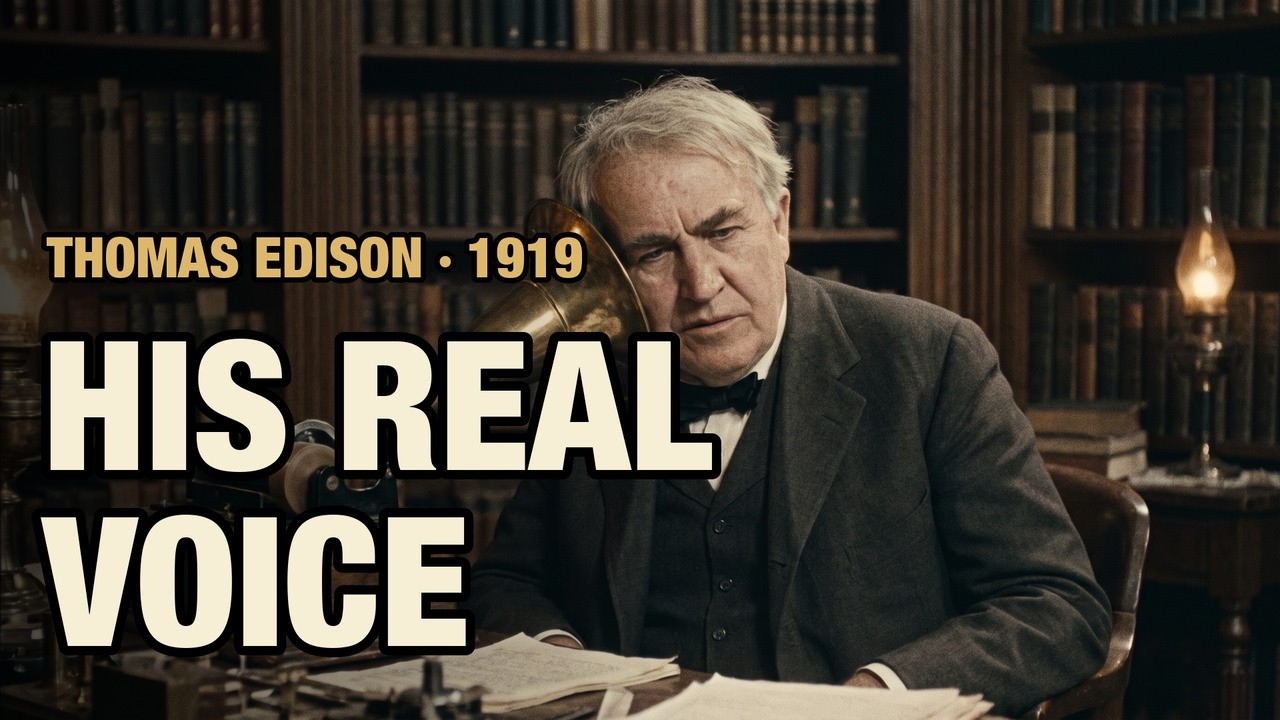
Here is the part we’re proudest of. The man who invented recorded sound refused, for four decades, to let his own voice be issued to the public — the announcer on the record itself marvels at it. He broke that rule exactly once, for a cause he decided was heavy enough: a memorial message called “Let Us Not Forget,” recorded as the First World War ended, honoring the fallen and the allies they fell beside. It is the only Edison voice recording ever released in his catalog. We restored it ourselves, and at the end of this episode you will hear it — not an impression, not a reconstruction, not a cast voice reading his lines. Him. Every recorded voice on Earth, including the two narrating this episode, descends from his machine. This is the ancestor speaking. Episode 68 publishes September 2, 2026.
📚 Sources
- Library of Congress — “Life of Thomas Alva Edison”
- PBS NewsHour — “The medical mystery that helped make Thomas Edison an inventor”
- Rutgers Edison Papers — “The Carbon Filament Lamp”
- Lacaux, Oudiette et al., Paris Brain Institute — “Sleep onset is a creative sweet spot,” Science Advances (2021)
- Smithsonian Magazine — “Edison vs. Westinghouse: A Shocking Rivalry”
- Smithsonian Magazine — “The Epic Failure of Thomas Edison’s Talking Doll”
- Rutgers Edison Papers — “Myth Buster: Topsy the Elephant”
- Library of Congress — Edison, “Let Us Not Forget” (1919)