A Mountain Falls Out of the Sky
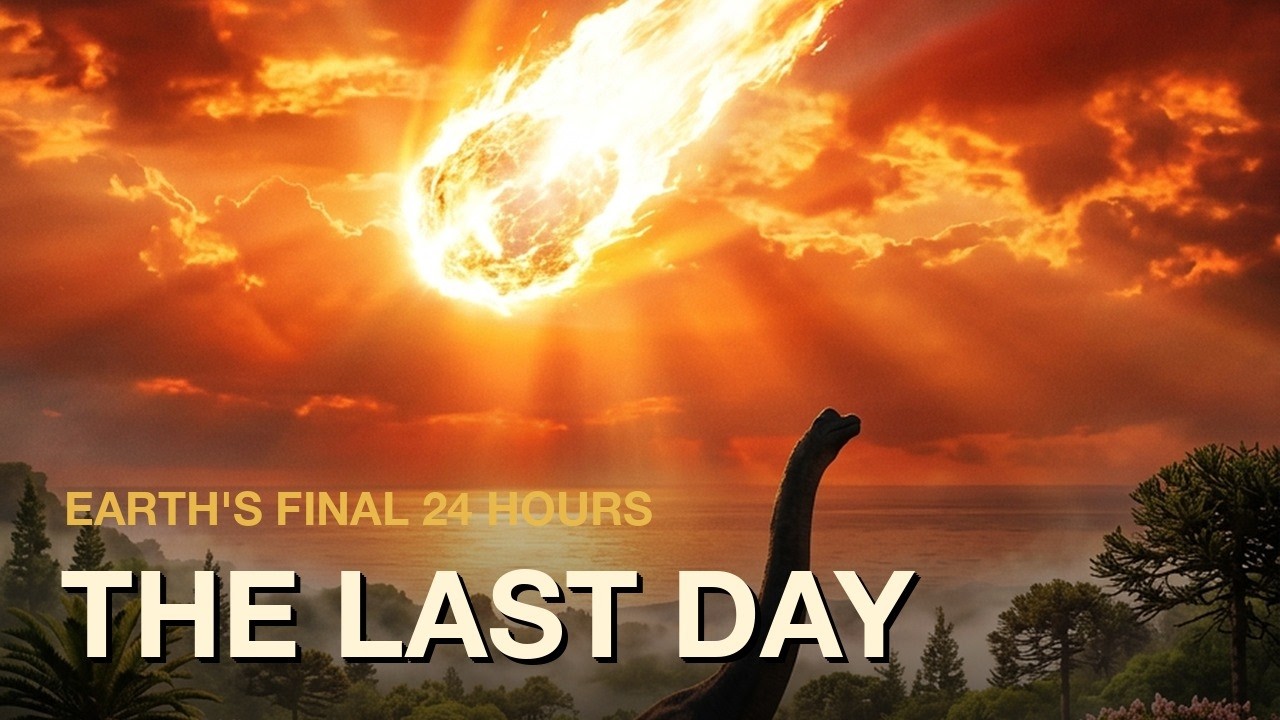
The rock was ten to fifteen kilometers across — taller, tip to base, than Everest — moving at about twenty kilometers per second, roughly sixty times the speed of sound. A 2024 isotope study of the boundary layer even identified its birthplace: a carbon-rich asteroid that formed beyond the orbit of Jupiter. At that speed, the entire atmosphere is less than ten seconds thick. At the moment of contact with the shallow tropical sea over Yucatán, the top of the rock was still above the cruising altitude of a jetliner. And thanks to two independent studies of fossil fish bones, we know something almost unbearably specific: it was spring in the Northern Hemisphere.
The First Hour, Fossilized
Three thousand kilometers away, in what is now North Dakota, a river was full of paddlefish. Minutes after impact, seismic waves arrived and sloshed the water into a surge that buried everything in its path — and the fish were entombed with tiny glass spherules, molten droplets of impact debris, lodged in their gill rakers. They were alive and breathing while pieces of the sky fell into the water. They died within tens of minutes to hours of the impact — which means the single worst catastrophe in Earth’s history is, at one site, resolved to roughly the length of a coffee break. The site has been argued about, as the episode says plainly — but the core finding is peer-reviewed, and it is the closest thing paleontology has to a stopwatch.
The Worst Twenty-Four Hours
The energy release was on the order of a hundred teratons of TNT — billions of Hiroshimas. Within minutes, a hole roughly a hundred kilometers wide and thirty deep; rock flowed like liquid, and a central peak higher than Everest rose and collapsed into a ring of mountains — confirmed in 2016 when a drill ship pulled pink granite from ten kilometers down out of that ring. The shaking was equivalent to magnitude ten or more. The initial wave near the crater stood on the order of a kilometer and a half tall; coastlines around the proto-Gulf took run-ups of a hundred meters. Then the sky itself turned hostile: vaporized rock, launched above the atmosphere, condensed into trillions of glass droplets that re-entered around the globe — and in the strong reading of the models, heated the upper air into an infrared broiler for an hour or two, lethal to anything large caught in the open, even on the far side of the planet. Whether the fires reached literally every forest is genuinely contested — the episode gives that dispute its honest airtime.
Who Lives
This is the question the whole episode is built around, and we won’t give away its best turns here. The short version: a few centimeters of soil or water blocked the thermal pulse, so the filter selected for creatures that could dig, dive, or wait. Freshwater ecosystems — fed by detritus rather than sunlight — came through at rates that seem impossible next to the land’s losses. Nothing much bigger than a house cat walked out. The only dinosaurs that made it were small, ground-dwelling, beak-equipped seed-eaters — you call their descendants birds. And every mammal alive, including every person listening, descends from a terrified little burrower that dug. The meek didn’t just inherit the Earth. They inherited it that afternoon.