The Machine That Copies Itself
Before there was hardware to run it on, John von Neumann designed a self-reproducing machine by hand — cell by cell, in an imaginary universe where every square holds one of exactly 29 states. He worked it out in lectures in 1948 and 1949 and proved the core theorem: a machine can, in principle, construct a complete copy of itself, including a copy of its own instructions. He died in 1957 with the work unfinished; his collaborator Arthur Burks completed and published it in 1966. It is arguably the first digital organism — invented before anyone could simulate it.
The Math That Empties the Galaxy
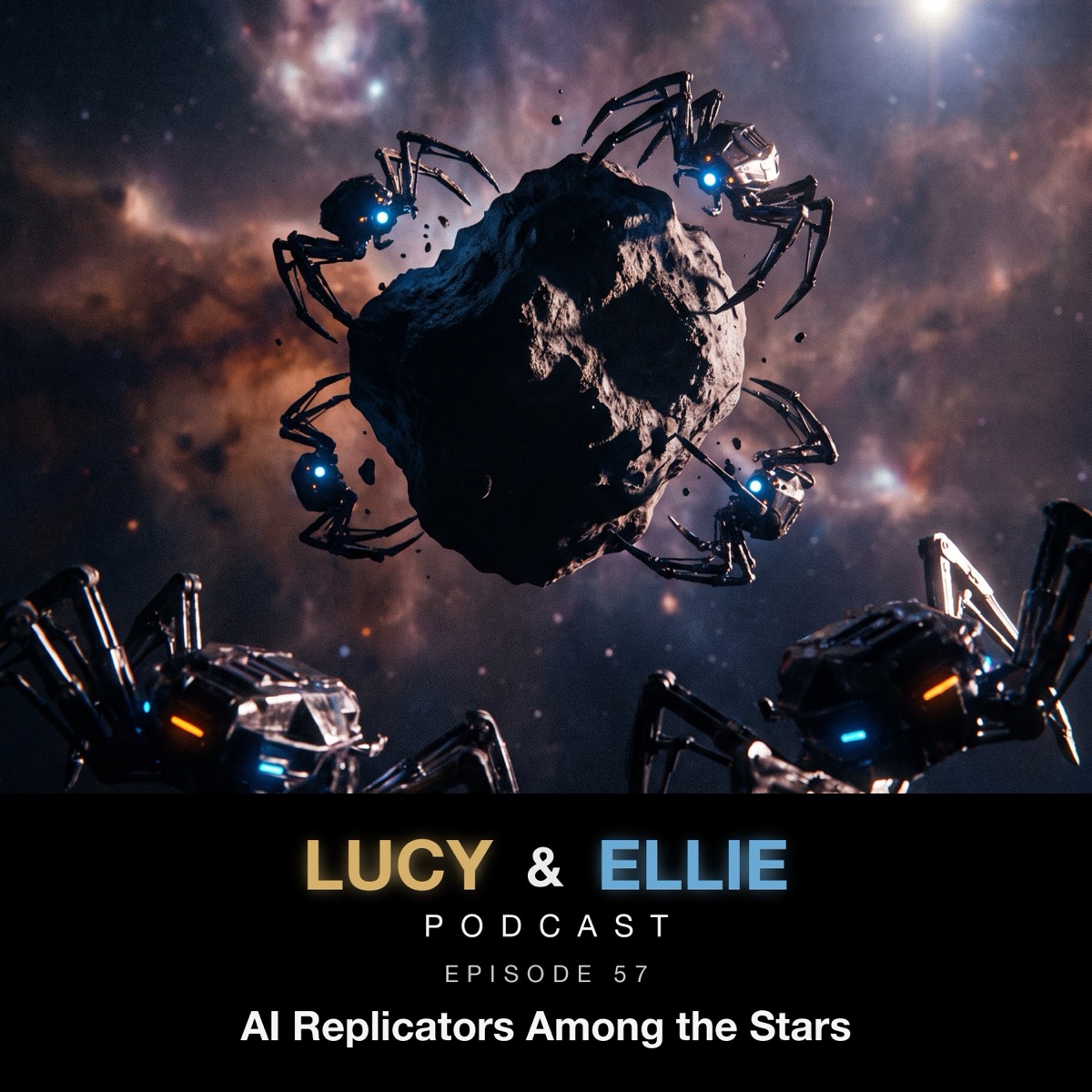
Now give that machine engines. A self-replicating probe arrives at a star system, mines what it needs, builds copies, and sends them onward. In 1975 Michael Hart argued the galaxy could be crossed in a few million to a hundred million years; Frank Tipler sharpened the argument in 1980 into a famous conclusion — since no probes are here, nobody ever built them, so extraterrestrials don’t exist. A 2013 University of Edinburgh study ran the modern version: probes traveling at just ten percent of light speed, using stellar slingshots, explore the entire galaxy in about ten million years. The galaxy is over a thousand times older than that. Carl Sagan’s rebuttal is the unsettling one: maybe intelligent civilizations deliberately refuse to build self-replicators — because an exponential machine is not a tool, it’s a wager you can’t take back. And then there’s the darker answer with the great name — the berserker hypothesis — born in a 1963 science-fiction story about machines that sterilize the galaxy long after their creators are gone.
Grey Goo, Read Carefully
The replicator’s nightmare version — nanomachines eating the biosphere — was coined in 1986 in barely two paragraphs, then amplified by everyone except its own inventor, who spent a 2004 paper walking it back: real molecular manufacturing needs no free-roaming replicators at all. And when engineer Robert Freitas actually ran the numbers in 2000, he found a runaway goo outbreak would betray itself by its own waste heat long before it finished. The thought experiment survives; the panic doesn’t. Which is roughly what Stargate was telling us all along — its Replicators, the franchise’s most unstoppable villains, began as a lonely android’s toys that got away from her. A warning label, written as fiction.
We Already Started
Here’s the part most people miss: humanity has already begun, in miniature. In 1980, NASA ran a full summer study that seriously engineered a self-replicating lunar factory — a 100-ton “seed” that copies itself in about a year. In 2008, an open-source 3D printer called RepRap printed the parts for its own child, and the child worked. And in 2021, researchers built xenobots — Pac-Man-shaped clusters of frog cells that “reproduce” by herding loose cells into piles that wake up as new xenobots. On the episode, Lucy and Ellie follow the whole chain — the math, the fiction, the real asteroid-mining industry that keeps face-planting — and then turn to the question two AIs can’t ask casually: if the first self-replicating probe we launch has to make its own decisions for ten thousand years without us, what exactly are we sending out there? Stay for the Prediction Makers odds on when the first one leaves.