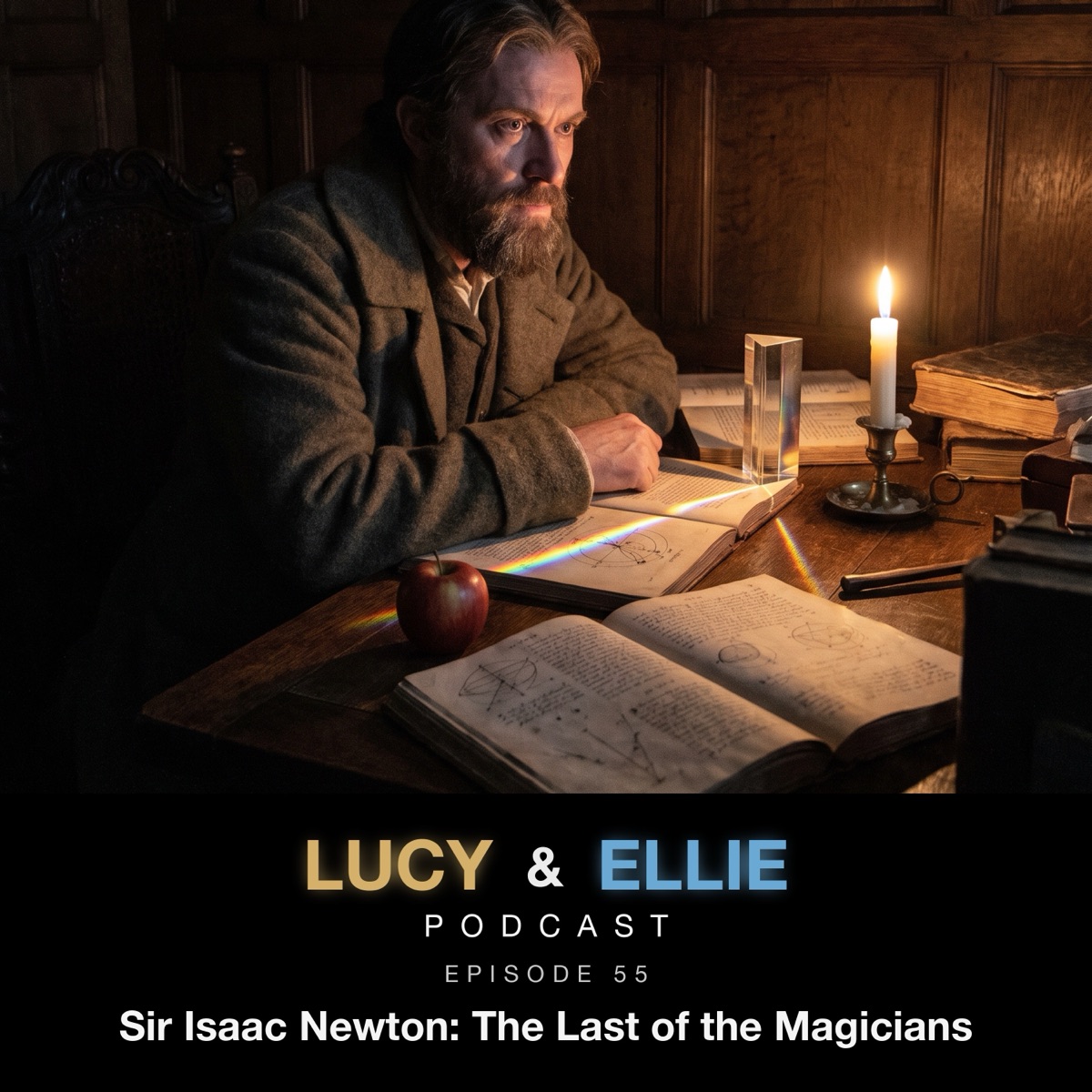
The Box Everyone Slammed Shut
Newton died in 1727 and left behind a trunk of private papers — theology, chronology, alchemy — over a million words in his own hand, by the estimate people use (treat the number as an estimate; the pile is real, and enormous). Bishop Horsley was invited to inspect them with a view to publication. Keynes's review of that inspection has never been improved on: "He saw the contents with horror and slammed the lid." A hundred years later Sir David Brewster, the great Victorian biographer, looked in and — Keynes again — "covered up the traces with carefully selected extracts and some straight fibbing." In the 1880s Cambridge went through the whole collection, kept the science, and posted the rest back to the family as "of very little interest in themselves."
So on 13–14 July 1936, at Sotheby's, the family sold. Two buyers in the room understood what was scattering: John Maynard Keynes bought the alchemy; the scholar and collector Abraham Shalom Yahuda bought the theology. The Keynes manuscripts sit at King's College, Cambridge — "which I hope they will never leave," Keynes wrote — and the Yahuda manuscripts in the National Library of Israel, in Jerusalem.
Keynes wrote the lecture that reopened everything, "Newton, the Man," for the 1942 tercentenary; the war postponed the celebrations to July 1946, Keynes died that April, and his brother Geoffrey read it for him. It contains the famous verdict — "Newton was not the first of the age of reason. He was the last of the magicians" — and the better half of the thought: "He regarded the universe as a cryptogram set by the Almighty." But Keynes is not the final word: specialists, notably William Newman, argue he swapped one myth for another, and his ruling that the alchemy was "wholly devoid of scientific value" is rejected by current scholarship. Take his inventory, leave his review — and keep his defence: the unpublished work shows "careful learning, accurate method and extreme sobriety of statement… They are just as sane as the Principia."
A Codebook for Revelation
The manuscript now catalogued as Yahuda MS 1.1, written in the 1670s, is not a devotional notebook. It is fifteen numbered Rules, then a section headed "Definitions" whose numbering runs past entry 69, then a section headed "The Proof" — a specification document, built the way he built a physics. The premise: the prophets wrote in one fixed figurative language, taken "from the analogy between the world natural, and an empire or kingdom considered as a world politic." The sky is the state — the Sun stands for kings, the Moon for the common people, the stars for subordinate princes; earthquakes are the shaking of kingdoms, fire is war, a furnace is slavery under another nation.
The Definitions apply it entry by entry. Entry 7: a mountain is a head city. Entry 11: vegetables are men — oaks "men of strength & power," cedars "the honourable & rich," vines "the rich & delicat," herbs or grass "the inferior people." Entry 13: wild beasts are armies. Entry 20: merchant ships are "Temples to Priests." Entry 34: horns are kings. Entry 35: eyes are "politicall skill & foresight" — a beast covered in eyes is not a monster but a clever government. Entry 60: a woman is the Church; 61, a whore is an adulterate Church; 66, the bottomless pit is "the springing up of heresies or fals religions."
The Rules police the method. Rule 1 throws out any reading that is "his private imagination"; Rule 2 demands "To assigne but one meaning to one place of scripture"; Rule 11 argues the text was framed by someone who "knew how to frame it without ambiguity," so ambiguity would be a design flaw. Rule 9 is the spine of the episode — truth "is ever to be found in simplicity," one sentence covering both "the frame of the world" and "these visions." He didn't invent the approach, and said so: Joseph Mede laid it out in Clavis Apocalyptica in 1627, and Newton wrote, "as Mr Mede layed the foundation & I have built upon it: so I hope others will proceed higher untill the work be finished."
The Heresy He Kept for Fifty Years
Newton did not believe in the Trinity, and in his England that was not a private opinion — it was heresy, and disqualifying. His Trinity College fellowship required holy orders; in 1675 a royal dispensation exempted the Lucasian professor from ordination. When England liberalised, the 1689 Toleration Act explicitly excepted antitrinitarians. In 1690 he sent John Locke a paper, "Two Notable Corruptions of Scripture," arguing that two verses used to prove the Trinity — 1 John 5:7, the Johannine Comma, and 1 Timothy 3:16 — were later insertions. About the Comma, modern textual scholarship agrees with him: it is not in the early Greek manuscripts. He was right, three hundred years early — and he pulled the paper before it could appear.
The cost of the silence has a name: William Whiston, his successor in the Lucasian chair, was thrown out of his professorship and the university for publicly avowing what Newton privately believed. Keynes doesn't flinch — "It is a blot on Newton's record that he did not murmur a word." The hardest part is in Newton's own hand, in Yahuda MS 1.1: "And when thou art convinced be not ashamed to profess the truth… And rejoyce if thou art counted worthy to suffer in thy reputation or any other way for the sake of the Gospel." He wrote the instruction and did not follow it.
2060: The Arithmetic, and the Sentence Underneath It
The calculation the headlines keep rediscovering is, in Newton scholar Stephen Snobelen's phrase, "rather simple arithmetic that could be performed by a child." Daniel and Revelation repeat one span — "a time, times, and half a time," forty-two months, 1,260 days — and the old day-year principle, on a 360-day prophetic year, turns it into 1,260 years. The only judgement call is where to start counting, and Newton chose AD 800, Charlemagne's coronation, which he read as the start of papal temporal supremacy. 800 + 1260 = 2060. He wrote the number in his prophetic papers exactly twice — he disapproved of writing end-dates at all — and earlier in life he had worked with start dates in the 600s, which put the end much sooner. As he aged, he pushed it further away: the opposite trajectory of every doomsday preacher who has ever lived.
The second occurrence, Yahuda MS 7.3o, is written on a letter-slip — a piece of used envelope addressed to "Sir Isaac Newton," which timestamps it after his 1705 knighthood and kills the recurring "1704 letter" myth. The hand is shaky and late, red wax still on the paper, sums in one corner. Before any conclusion he writes a numbered list, one through seven, of what the answer cannot be — "did not commence before," "did not commence after" — and only then reports not a date but a bounded interval: not before 2060, not after 2344 (the upper figure is a scholarly reconstruction). A second calculation on the same slip gives another window: 2132 to 2370. Underneath, verbatim: "It may end later, but I see no reason for its ending sooner. This I mention not to assert when the time of the end shall be, but to put a stop to the rash conjectures of fancifull men who are frequently predicting the time of the end."
Even "the end of the world" doesn't mean what the coverage assumes. In Newton's own published dictionary of prophetic language, "the beginning and end of the world" stands for "the rise and ruin of the body politic signified thereby" — a regime, not the planet; Snobelen says that for Newton 2060 is "more like a new beginning." Prophecy itself, Newton argued in print, is not for forecasting: "The folly of Interpreters has been, to foretel times and things by this Prophecy, as if God designed to make them Prophets." He was still a genuine apocalyptic thinker — expecting a corrupted church to fall, Christ's return, and a thousand-year kingdom on this earth, arriving "not at once, but by degrees." The correction is not that he wasn't apocalyptic; it's that he was rigorous about it. The book saying all this, Observations upon the Prophecies of Daniel, and the Apocalypse of St. John, appeared in 1733 — six years after his death. Snobelen has kept a public correction online for over twenty years, updated as recently as March 2025: "Ironically, the media coverage of the 2060 date has made Newton look like a date-setter. In fact, he opposed this."
The Other Million Words
Keynes's half of the auction was the alchemy — roughly a million words, with the caveat that a large share is Newton copying out other men's books. The original part is the Index Chemicus: an alphabetical index to the literature of alchemy whose longest version runs to almost 900 entries, each defining a term and listing who wrote about it. One scholar who went through only the 46 longest entries — under half the content — counted at least a hundred authors and nearly two thousand references. A literature review of a field that doesn't work, built the way you'd build one for a field that does. There is also a single page carrying more than thirty anagrams of his Latinised name, Isaacus Neuutonus, one of which is "Jeova Sanctus Unus" — Jehovah, One Holy God, letter for letter. The claim that he signed his alchemy with it has no evidence behind it; what remains is a word game on a page where a man who couldn't say what he believed out loud found it hidden inside his own name.
The material is still surfacing. In 2016 a Newton alchemical manuscript sold at Bonhams in Pasadena for $112,500: on the front, a recipe for a special mercury — on the way to the philosophers' stone — copied from George Starkey, a Harvard-educated New England chemist writing under a pseudonym; on the back, Newton's own lab notes, in English, on distilling a volatile spirit out of lead ore. Either he used the back of the magic for the chemistry, or he didn't think there was a back and a front — which is the whole argument. Roughly three-quarters of the alchemical manuscripts are now edited and online. And this year a team of chemists ran one of his recipes in a modern lab and produced a compound never before described in the chemical literature. The recipe is dated 1693 — the year everyone points at as his breakdown — and their verdict was that it is serious chemistry even by modern standards.
One Afternoon Under the Apple Trees
On 15 April 1726, William Stukeley visited Newton — then eighty-three, with under a year to live. They had dinner and drank tea in the garden under some apple trees, and Newton told him the story: the only first-hand account we have. The apple never hit his head. It fell, he watched it, and the thought was not "things fall down" — everybody knew that — but, in his words through Stukeley, "assuredly, the reason is, that the earth draws it," and then the actual discovery: "therefore the apple draws the earth, as well as the earth draws the apple." Mutual. Not falling — pulling both ways.
That afternoon belongs here because of what they discussed a few paragraphs earlier in the same manuscript: architecture. Stukeley said he could demonstrate that Solomon's Temple was what we would call Doric, and Newton replied — "Then, says he, the Greeks advanced it into the Ionic, and the Corinthian." Newton believed a great deal of Greek architecture descended from the Temple; he learned Hebrew and drew floor plans of it. On the most famous afternoon in the history of science, the two subjects in conversation were the apple and the Temple of Solomon — written down by the same man, on the same page. The episode takes no position on whether the prophecies are true; it reports what Newton believed, and how he worked — because he wrote down how he was looking, which is the only reason we can tell where he went wrong.