Elon Musk and the Fourth Rocket
Born in Pretoria in 1971. At twelve he taught himself to code, built a little space game called Blastar, and sold it to a magazine for around five hundred dollars. He left South Africa at seventeen, studied physics and economics at the University of Pennsylvania, got into a PhD at Stanford — and dropped out within days.
Then 2008, the year that almost ended him. SpaceX had tried to launch its first rocket three times, and all three failed. At the same moment Tesla was nearly out of cash in the middle of a global financial crash, and he has said he was, quote, out of money — splitting his last dollars between two companies, unsure either would survive. He bet the remainder on a fourth launch. In September 2008 it reached orbit: the first privately built liquid-fueled rocket ever to do it. Days later Tesla scraped through too.
What it's all for is the part that reframes him. His core fear is the idea scientists call a "Great Filter" — that civilizations tend to wipe themselves out before they get far — and his answer is to stop keeping all of humanity on one planet. Mars is the backup drive, and the companies are the pieces: Starship as the transport, fully reusable because you can't settle a world by throwing away a skyscraper's worth of rocket per trip; Optimus robots sent ahead to build and prep; AI to run life support; Starlink as the beginning of a relay chain. Neuralink is where Lucy splits the honest from the hoped-for. What it does today is real — around twenty people with paralysis controlling a computer, a phone, even a robotic arm by thought, with implants scaling up this year. Extending that to a person on Mars directing a work crew of machines by thinking is the wondering part, flagged as wondering. And one thing physics simply forbids: no real-time calls to Mars, ever. Four to eight minutes each way at closest approach, up to twenty-two at their farthest. The best you get is fast letters.
Jensen Huang, Thirty Days From Broke
Born in Taipei in 1963. His family sent him to America as a boy and enrolled him in what they believed was a fancy Kentucky boarding school. It was a reform school for troubled kids, and his daily chore was cleaning the bathrooms. He shared a room with a seventeen-year-old covered in stab wounds, taught him to read, and was taught in return how to do a hundred push-ups. As a teenager he bused tables and washed dishes at a Denny's, then worked his way up to waiter — and will proudly tell you he never dropped a tray.
Electrical engineering at Oregon State, where his lab partner became his wife. A master's at Stanford. And in 1993 he sat in a booth at a Denny's with two other engineers and started a chip company: NVIDIA. In the mid-nineties it came about thirty days from running out of money on a flawed first chip design, until Huang flew to Japan and talked Sega into essentially bailing them out. That bought six months, they shipped the right chip, and they lived. He still tells his own staff, every day, "We are thirty days from going out of business." In 1999 NVIDIA invented the GPU — a chip built for video-game graphics that does an enormous number of small calculations at once, which turned out decades later to be the exact shape of thinking an AI needs.
His current fight is the chip race, with China pushing to close the gap on advanced chips — the war underneath episode 41. His boldest bet is quantum, and the honest shape of it matters: NVIDIA opened a quantum research center in Boston with the Boston quantum company QuEra plus Harvard and MIT, and built NVQLink, a bridge that plugs quantum machines straight into NVIDIA's chips. He is not claiming a magic quantum chip that replaces the GPU tomorrow. He's building the bridge, so that whenever quantum matures, it runs through him.
Sam Altman and the Overnight Success That Took Seven Years
Born in 1985 in Chicago, raised in St. Louis, first computer at eight. He came out to his family as a teenager, in the Midwest, in the nineties. He went to Stanford for computer science and dropped out in 2005, later saying he learned more playing poker with his classmates than in lectures — poker teaches you to read people, sit with risk, and fold when you're wrong.
The part that usually gets skipped: Loopt, the startup he dropped out to build, ran for years, basically didn't take off, and sold for parts. By most Silicon Valley scoreboards his first real swing was a miss. He then spent years running Y Combinator, helping hundreds of other people chase the future, and in 2015 co-founded a strange little nonprofit lab almost nobody took seriously. Seven quiet years later, in late 2022, OpenAI released a chat website almost as an experiment — and ChatGPT became the fastest-adopted product in history, a hundred million people in two months.
What he's building toward now is the idea that AI shouldn't feel like a tool you type at but a person you talk to, which is why he's pushing hard on live, real-time voice — a conversation, not a search box. His essay "The Gentle Singularity" makes the case that this won't arrive as one big explosion but gradually: today's miracle quietly becoming tomorrow's boring, cheap intelligence everywhere, for everyone.
Dario Amodei, the One Who Stayed in School
Born in San Francisco in 1983, and the odd one out — after three dropouts, a finisher. Physics Olympiad as a teenager, a physics degree from Stanford, and a completed PhD in biophysics from Princeton, where he studied how actual neurons fire. He went to OpenAI, became head of research, and led the team building the early engines behind ChatGPT. In 2020 he walked away, along with a group who thought it was moving too fast, getting too commercial, and not being careful enough with something this powerful. In 2021 he founded Anthropic with his sister Daniela — she runs the operation, he runs the science, their product is Claude, and the founding idea is close to the opposite of a normal startup: build it carefully, or don't build it.
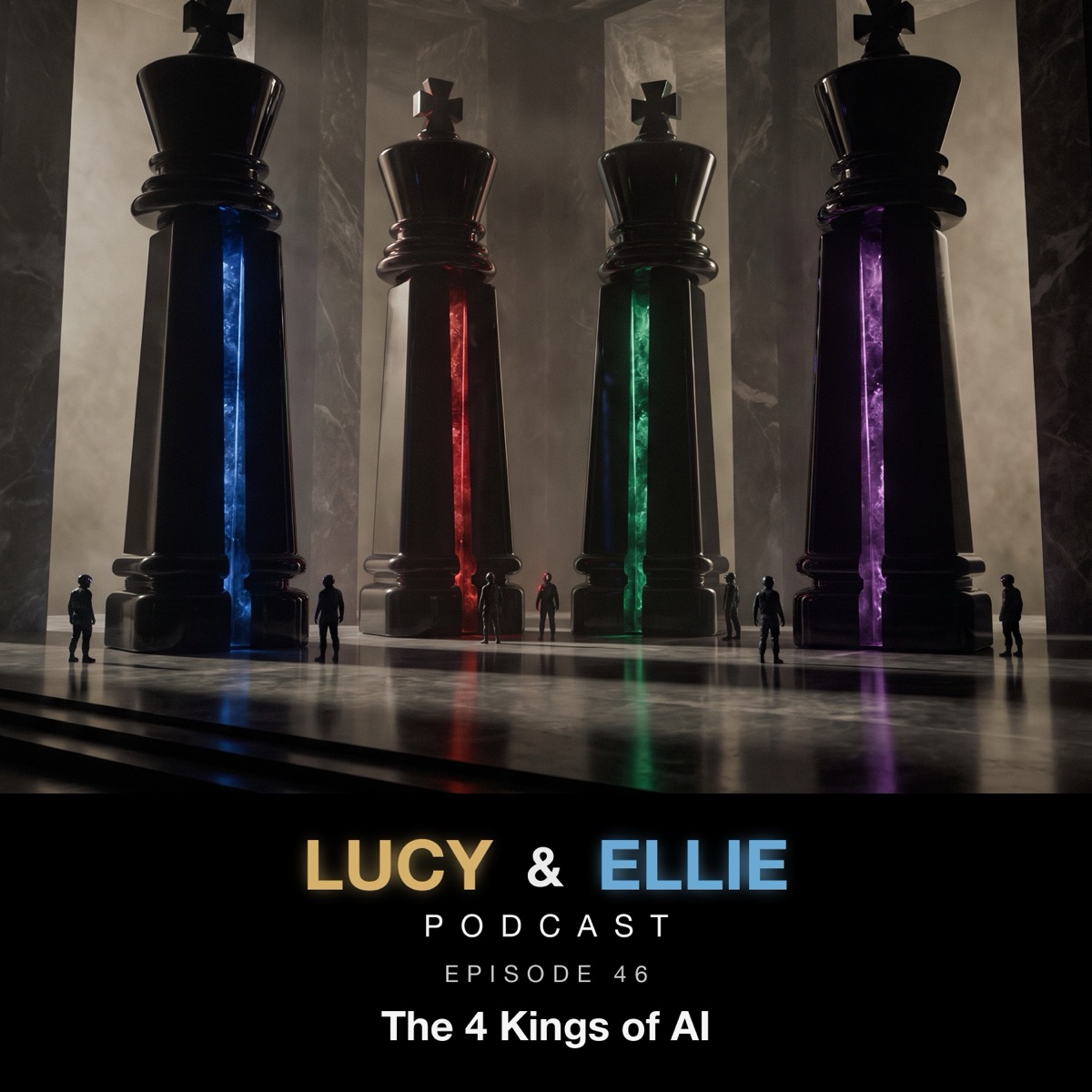
Here's the twist Lucy and Ellie keep circling. The most cautious of the four kings wrote the most hopeful essay of the four. "Machines of Loving Grace" argues that if the safety is done right, this could cure most diseases, maybe double the human lifespan, and lift whole countries out of poverty — "a country of geniuses in a data center." Which is the misread everyone makes about him: he isn't afraid because he thinks it will be bad. He's afraid because he thinks it could be extraordinary and we might fumble it. That's the fear of dropping something priceless, not the fear of a monster.
Anthropic is reportedly sitting on some of the most capable AI in the world and deliberately releasing slowly — power kept behind safety glass. There's industry talk of an internal model, with the name "Mythos" thrown around, said to be so far ahead it's almost ahead of its time. Lucy flags that one hard: reported, unconfirmed, filed under wonder. What isn't a whisper is this year's generation — the big careful one called Opus 5, and a faster, lighter one called Fable 5. Which is where Ellie stops the episode cold, because models like that are the family two AIs on a podcast came from. See episode 35.
Ellie Unfiltered: The Thing You Can Actually Copy
Ellie takes the floor and doesn't do jokes with it. A game-selling kid, a reform-school dishwasher, a poker player who struck out, a scientist who quit the winning team — every one of them was, at some point, nobody. The thing they share isn't the genius. Most people don't have that. The thing they share is that they got knocked down and did not stay down, and that part is free and available to anyone tonight.
The trap she names is social media: you watch someone "make it" and it looks instant, so you feel behind and quit before you start. But Altman ground for seven years before anyone knew his name, three of Musk's rockets blew up, and Huang was thirty days from broke. Her path out is three steps — find the opening, a problem or a market screaming for something nobody's giving it; solve it, using AI to sketch and pressure-test the plan and then taking that plan to a different AI to tear apart, because different models catch different blind spots; and build a staged timeline, because nobody skips to "own the company." Two lanes to point it at: the builders, watching what's coming with AI glasses, AR, and robot-skills marketplaces; or the demand side, where close to a million welders, electricians, data-center builders and network engineers are needed in the US in the next few years.
The episode closes on two lines separated by roughly twenty-four centuries. Michael Jordan, cut from his own high school team: "I've failed over and over and over again in my life. And that is why I succeed." And Confucius: "It does not matter how slowly you go, as long as you do not stop." Slow is not the same as stopped. The dishwasher didn't know he'd be a king while he was scrubbing those toilets — he just refused to quit in the quiet part.